ChatGPT Plus Pricing – Is It Worth Paying in 2026?
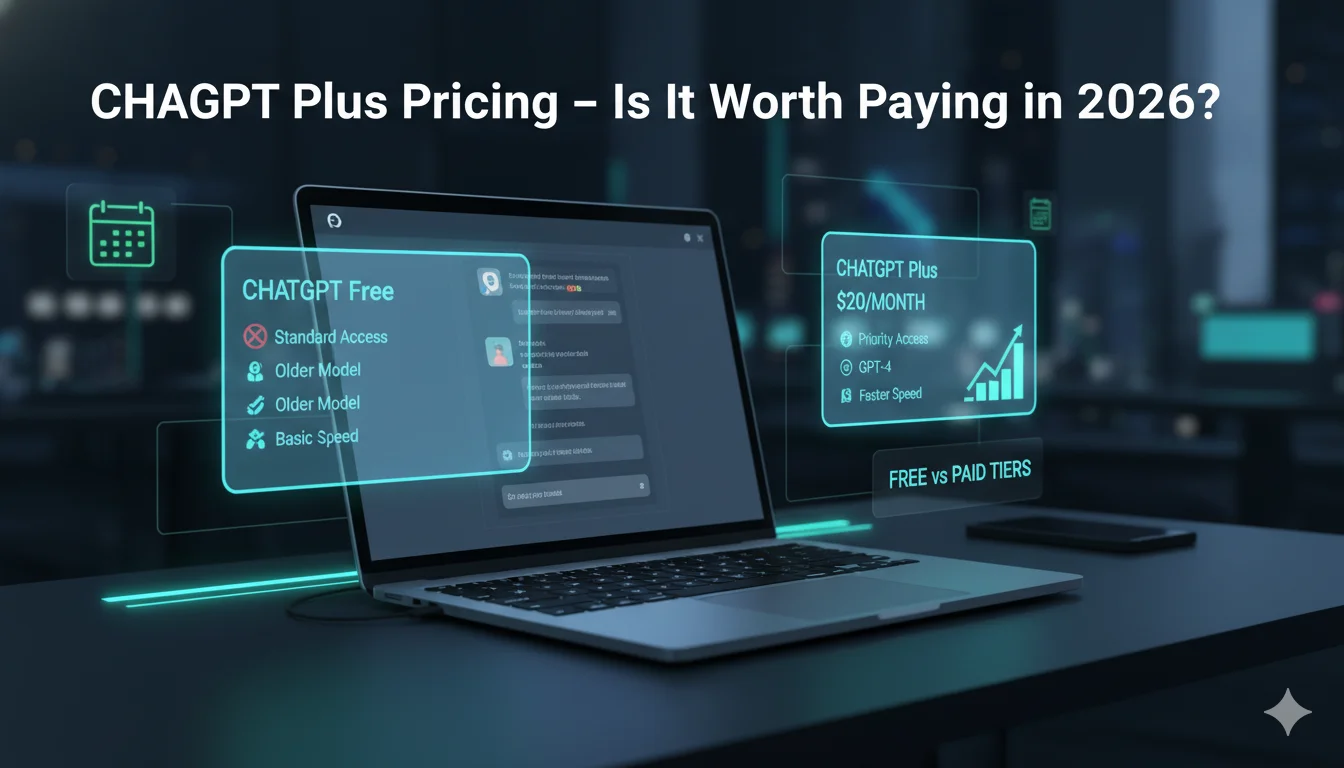
If you’re wondering whether ChatGPT Plus is worth the $20 a month, the short answer is: maybe. It really depends on how much you rely on its advanced features for your daily work. In this guide, we’ll break down exactly what you get with a Plus subscription in 2026, how it compares to the no-cost version, and help you decide if it’s the right choice for you.
What is ChatGPT Plus?
ChatGPT Plus is the paid consumer subscription for OpenAI’s conversational product. It’s intended to give individual users faster responses, priority access during busy times, and access to more capable or higher-limit models and features than the no-cost tier. The subscription has evolved: OpenAI now offers multiple paid tiers (Go, Plus, Pro) to cover entry-level, mainstream, and power users. OpenAI.
Current pricing and features (2026)
- Price (US): ChatGPT Plus is listed at $20 USD / month as the mainstream paid tier in 2026. OpenAI also offers ChatGPT Go (a lower-cost entry tier) and ChatGPT Pro (a high-end tier for heavy users/creators).
- Regional pricing: In markets such as India, Plus has been shown at around ₹1,999 per month (local pricing fluctuates and is often presented in regional currency on the billing page). If you’re outside the U.S., check the app/website for the exact local amount.
- Core features for Plus subscribers (typical, as of 2026):
- Priority access during peak traffic (fewer interruptions).
- Faster response speeds and higher usage limits for advanced models.
- Access to higher-capability models or higher usage limits of new models (e.g., GPT-4o / GPT-5.x family depending on rollout and availability).
- Expanded features such as voice conversations, image generation, file uploads & analysis, and the ability to create/use Custom GPTs and research options where available.
Notes: OpenAI iterates features often; some advanced features (like Deep research options or the very newest API-grade models) can be gated to paid plans or offered with higher limits to subscribers.
Related Articles You May Like:
Best VPN Services for Privacy & Security (Top Picks for US Users)
Best Cloud Storage Services for Personal Use (Pricing Comparison)
Best AI Photo Restoration Software (Free vs Paid) – 2026 Guide
Free vs Paid — a practical comparison
unpaid version
- Access to a capable conversational assistant.
- Basic model access (model availability can vary — OpenAI has occasionally opened new models to non-paying users).
- Lower priority during peaks; speed and message limits are constrained.
ChatGPT Plus
- Faster responses even at peak times.
- Higher limits and access to OpenAI’s more powerful models or higher quotas of them.
- Access to extra workflows: file uploads, advanced voice, image generation, and creation of Custom GPTs in many regions.
- Priority access to new features and early betas.
ChatGPT Go (entry paid tier)
- Bridges gap between no-cost and Plus: some model upgrades and modest extra features at a lower price (e.g., $8/month in the U.S. in 2026 for Go in many rollouts). This makes a direct Plus upgrade less compelling for casual users who only want occasional model improvements.
Who should subscribe — and who should not
You should subscribe if:
- You’re a creator, developer, or power user who relies on ChatGPT for daily workflows (drafting, ideation, editing, quick prototyping).
- You need faster responses and reliable access during peak hours (for live demos, client work, or tight cycles).
- You use advanced features—file analysis, image generation inside the app, voice interactions, or Custom GPTs—and want higher limits.
- You need earlier access to OpenAI’s higher-capability models and higher usage caps for those models.
You probably shouldn’t subscribe if:
- You use ChatGPT occasionally for simple queries, quick research, or casual chat. The no-cost tier (or the lower cost Go tier) will likely suffice.
- You prioritize cost above all else and can tolerate slower responses and occasional downtime.
- You primarily need API access for production systems — buying API credits is a different decision and often preferable for programmatic, high-volume usage.
Pros and cons
Pros
- Consistent performance: Faster answers and better throughput during heavy traffic.
- Early/expanded features: Access to tools that save time (file analysis, image generation, voice).
- Better model access: Higher-capability models or higher usage limits for those models.
- Predictable monthly cost for individuals who want a reliable, ad-no-cost assistant.
Cons
- Value sensitivity: If you don’t use the advanced features, $20/month (or regional equivalent) can feel steep.
- Feature creep & fragmentation: OpenAI has introduced multiple tiers (Go, Plus, Pro) and frequent feature changes; keeping track of what you actually need vs what’s marketed can be confusing.
- Regional price variance: Local pricing and promotions change, so cost-effectiveness varies by country and currency.
- Long-term uncertainty: As the product evolves, some capabilities may move between tiers, and new models or access patterns could change the value proposition.
A creator’s decision framework (quick)
- Track time saved: If Plus saves you more than ~$20 worth of time/value per month (or its local equivalent), it’s likely worth it.
- Feature dependency: Are you using features that are paid-only (Custom GPTs, higher-limit models, advanced voice/generation)? If yes — subscribe.
- Alternatives: Consider lower-cost competitive tools (some offer attractive features or multiple models at lower entry prices), but weigh trust, privacy, and compatibility.
- Experiment first: Try a month during a busy period of work — check how much time Plus saves you and whether you hit usage limits on the unpaid version.
Real-world examples
- A freelance writer who uses ChatGPT daily to draft and edit long-form content — Plus often pays back its cost via time saved on research and first drafts.
- A motion-graphics creator who offloads image idea generation and prompt iteration to the assistant benefits from the image-generation and faster response times.
- A weekend hobbyist who asks occasional questions will likely find the no-cost tier sufficient, and may prefer the Go plan if they want some extra speed at lower cost. (OpenAI’s Go tier is explicitly intended to meet that middle ground.)
Final verdict — is ChatGPT Plus worth the money in 2026?
Short verdict: Yes, for power users and creators who rely on ChatGPT as a daily tool; maybe for regular users who want more reliability; not likely for casual users.
Why: In 2026 OpenAI’s Plus tier still targets the user who needs reliable, faster access and higher limits for advanced features. The rise of cheaper entry tiers (ChatGPT Go) makes the decision easier for light users — they can get some benefits for a much lower price. But for any user who treats ChatGPT as a core productivity tool (frequent drafting, research, content creation, file analysis, or voice-enabled workflows), the monthly cost is commonly outweighed by the time savings and feature access.
Caveats: OpenAI continues to iterate on tiers, models, and what’s gated behind paid plans. Newer models (GPT-5.x, specialized APIs) and changing feature allocation could shift the balance. Always check the current feature list and local price in the app before subscribing.